The rise of gays and lesbians could probably be attributed to the birth of a more liberal society, as prominently observed in the West.
People are beginning to explore arenas never once thought of by the ancient conservative Stone Age humans. In ancient China, the staunch belief of everyone - men and women alike - is that women are born to serve men. A women's duties are to the household - to cook, wash, look after the children, and of course the most important of all, to carry on the family name. Every men's duties are to work and be a financial provider of the family. Everyone conformed to that ideology, simply because they were all brought up and instilled with these values since young.
There were no TVs or western influences that could penetrate as deeply into the society now than compared to the past. Hence, the Chinese were not affected, to say the least, by external influences.
Then came the period were everyone said goodbye to their pigtails and embraced a slightly more liberal society. But still, these ideologies were adhered to.
Slowly, external influences were brought about by the increasing number of TV sets and computers due to the country's affluence. This is when the big change starts taking place, moulding to society and teens largely based on what they see online or no TV screens.
Eventually, here we are today - where sex is an essential and integral part of a relationship (whether you are married or not. In the past, a couple can only consumate after marriage. People who are pregnant before marriage are deemed as black sheeps, and in some part of China, are stoned to death, literally.), when we rely more on Internet then ever, an era where our beliefs are constantly changing, dictated by Hollywood stars like Miley Cyrus, Linsay Lohan, Britney Spears and whoever else.
The advancement of technology had also aided in speeding up this process. Today, if you're unhappy about your own sex, no problem, just visit the doctor to do a transexual operation. The only deterring factor is probably money.
What sparked me to write such an article is after reading an article written by Mr. Ho Kwon Ping, which was published in TODAY on Sept 8th.
Click here to read more about Mr. Ho's article.
Personally, I do agree with Mr. Ho's views on gay sex, but only to a small extent.
#1: Gays are tolerated, not accepted.
Mr. Ho argued that there is a significant difference in gays being merely "tolerated because gays are seen to be at the leading edge of the "creative class" ... and being accepted..", which I agree. Gays are fundamentally humans, or in scientific terms 'homo sapiens'. They deserve the same respect and dignity that every other individual deserves.
In its Declaration on the Principles of Tolerance, UNESCO offers a definition of tolerance that most closely matches our philosophical use of the word:
Tolerance is respect, acceptance and appreciation of the rich diversity of our world's cultures, our forms of expression and ways of being human. Tolerance is harmony in difference. - http://www.tolerance.org/about/tolerance.html
Another definition of TOLERANCE (n.):
The capacity for or the practice of recognizing and respecting the beliefs or practices of others. -http://www.thefreedictionary.com/tolerance
The definition of Acceptance, on the other hand, though encompassing almost simliar meaning to that of "tolerance", is distinctly different.
ACCEPTANCE:
1. The act or process of accepting.
2. The state of being accepted or acceptable.
3. Favorable reception; approval.
4. Belief in something; agreement.
-http://www.thefreedictionary.com/Acceptance
The main essence carried in the word "acceptance", which draws a line from "tolerance" is the word "favourable". It carries nuances of emotions which are good, or shed a good light on whatever people have come to consensus with.
Hence, "tolerance" is not tantamount to "acceptance".
Therefore, I have successfully proven that these 2 terms are distinct, yet simliar in some ways. However, do note that I did not express that I agree to the legalising of gay sex.
#2: Decriminalise Gay Sex In Singapore
Secondly, Mr. Ho argued that since many countries have "decriminalised' (in Mr. Ho's terms) gay sex, and had even allowed or celebrated gay marriages across the globe, Singapore should do the same too.
He pointed out that "Singapore is known to be economically liberal, but socially conservative."
Below are some sources I've found to state Singapore's current stand on the matter:
In an article published in Oct 24, 2007:
"Singapore has legalised oral and anal sex between heterosexual couples, but retained a law which criminalises intercourse between gay men.
In the city-state's first major penal code amendments in 22 years, parliament repealed a section criminalising "carnal intercourse against the order of nature".
Parliament however kept the penal code's section 377A, which makes sex between men a criminal offence, rejecting a petition by gay rights activists and their non-homosexual supporters to abolish the law as well."
History of Gay in Singapore:
When the Japanese invaded Singapore in February 1942, Japanese laws replaced previous colonial laws. Gay sex was never criminalised in Japan and would now have been technically legal in Singapore. However, given the lack of human rights and rule of law under the Japanese occupation, this change in law was a technical and historical quirk, reflective of a different legal tradition, rather than an expansion of real rights for gay people.
Anecdotally, gay cruising continued in post-war Singapore in back alleys, public parks and toilets. In the most part, this was ignored by the police and no one was charged under section 377 of the Singapore Penal Code.
Did You Know?
Homosexuality and transsexuality were listed as conditions in a Singapore Armed Forces (SAF) 'Directory of Diseases' (disease code 302).
Source: Wikipedia -http://en.wikipedia.org/wiki/Singapore_gay_history
Yes, I agree that many countries are legalising gay sex in their legislations. Among them are countries such as Jerusalem, Japan and most evidently seen in European nations.
JERUSALEM:
January 16,2004
The Jewish Community Relations Council, the major public policy voice of the Jewish community in Greater Boston, has voted overwhelmingly to endorse same-sex marriage.
Several Jewish organizations had already endorsed same-sex marriage, including the largest Jewish denomination in the country, the Union for Reform Judaism, and the Northeast region of the Central Conference of American Rabbis, the association of Reform rabbis that voted unanimously this week to support same-sex marriage. But same-sex marriage is opposed by leaders of Orthodox Judaism, a denomination that makes up a small minority of Greater Boston's 250,000-member Jewish community. The board of trustees of the Jewish Community Relations Council, made up of Jewish religious and social service organizations and prominent Jewish individuals, on Wednesday night voted 51-5 in favor of the resolution endorsing same-sex marriage. -http://www.boston.com/news/local/articles/2004/01/16/jewish_group_oks_same_sex_marriage/
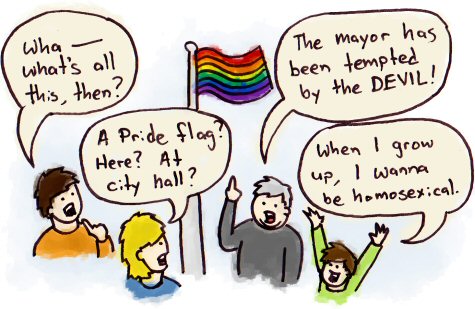
Many gays commerate or celebrate their decision with thousands other gays alike in an annual event called the World Pride. World Pride is an international gathering of homosexual, lesbian, bisexual and transgendered individuals scheduled in Jerusalem in August. World Pride is a 10-day festival planned meticulously by gay leaders worldwide.
The Mission Statement for WorldPride 2006 is clear: “Jerusalem WorldPride will come to Jerusalem. Jerusalem WorldPride 2006 will bring a new focus to an ancient city through a massive demonstration of [Lesbian, Gay, Bisexual, and Transgender] dignity, pride, and boundary-crossing celebration...from the home of the world’s three great religions; we will proclaim that love knows no borders.”
JAPAN:
Unlike in Muslim countries, homosexuality is legal in Japan. Male prostitution is unregulated by the law and Tokyo bans anti-gay job firings. As a primarily Buddhist and Shinto nation, there's very little in the way of religious discrimination. There's also no shame attacted to depicting same-sex love in books, comics, and television.
NETHERLANDS:
They saw their first gay-marriage in 2001.
Around the world, countries are coming to terms with how to treat homosexual couples - and the trend in many is toward liberalizing laws. In Denmark, civil unions with the same rights as marriage have been around since 1989, and other Nordic countries followed suit in the 1990s.
The Dutch were the first to eliminate any distinction between gay and straight, striking all references to gender in the marriage laws. Belgium soon did the same. Canada jumped to the forefront of gay rights in North America in June when it announced plans to legalize same-sex marriages.
Many same-sex couples streamed north to marry in Ottawa and British Columbia after courts in those provinces authorized weddings.
In most of Africa, homosexuality is illegal and gay marriage unthinkable. But in South Africa, gay rights were enshrined in the post-apartheid constitution and some groups are lobbying for the right to marry. -http://www.cbsnews.com/stories/2004/03/04/world/main604084.shtml
Here is the legal status of gay marriage in Europe and other parts of the world:
Belgium: Legalized gay marriage in 2002.
Britain: Plans to introduce legislation soon authorizing civil unions giving gay couples legal recognition with most of the rights enjoyed by married partners.
Canada: Considering legislation to legalize gay marriage.
Denmark: The first country to legalize same-sex unions in 1989, later giving couples adoption rights. Other Nordic countries followed in the 1990s.
France: Allows civil unions since 2000.
Germany: Introduced civil unions in 2001.
Italy: Does not recognize same-sex unions.
The Netherlands: Became the first country to legalize gay marriages outright in 2001.
Portugal: Lesbian and gay couples who live together acquire the same rights as heterosexuals in common-law marriages.
Spain: Like most Roman Catholic countries, Spain does not recognize gay unions. But some northern regions, such as Navarra and the Basque country, recognize gay common-law couples and accord them rights of spouses.
South Africa: Recognized gay rights in its constitution after apartheid ended in 1994. Activists are preparing litigation to have the common law definition of marriage extended to include same-sex couples.
Switzerland: Its largest city, Zurich, started recognizing registered gay couples last July. Geneva also recognizes same-sex couples, although grants them fewer rights. Swiauthorities are considering whether to introduce a national law to harmonize treatment throughout the country.
Source: AP
However, I beg to differ pertaining to Mr. Ho's call for Singapore to legalise gay sex.
And there are signs that the world has yet to come to terms with the notion totally.
Let me prove it to you.
JERUSALEM:
The religious leaders, Sheik Abed es-Salem Menasra, deputy mufti of Jerusalem; Rev. Michel Sabbagh, Latin patriarch; Rev. Aris Shirvanian, Armenian patriarch; Rabbi Shlomo Amar, Sephardic chief rabbi, and Rabbi Yona Metzger, Ashkenazi chief rabbi expressed their concern that the festival (World Pride) would desecrate the holy city and communicate the mistaken impression that homosexuality is acceptable.
Shlomo Amar said, “They are creating a deep and terrible sorrow that is unbearable. It hurts all of the religions. We are all against it.”
Dr. Michael Evans said,"..you can be certain that WorldPride’s gay pastors will proclaim to the citizens of Jerusalem that the homosexual populace is wonderful Christians who represent you and me. If it happens every Jew worldwide will see this sight, as well as the one billion Muslims. All will think that is who we are and what we represent."
USA:
Feburary 25, 2004
WASHINGTON (CNN) -- President Bush endorsed a constitutional amendment Tuesday that would restrict marriage to two people of the opposite sex but leave open the possibility that states could allow civil unions.
"The union of a man and a woman is the most enduring human institution, honored and encouraged in all cultures and by every religious faith," Bush said.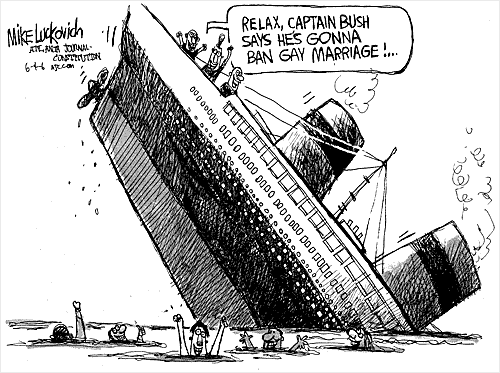
June 27, 2008
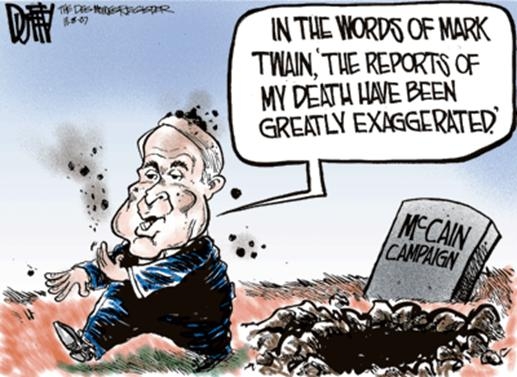
SAN FRANCISCO—After several weeks of silence on the issue of same-sex marriage, Sen. John McCain has made it official. The presumptive Republican nominee for president has endorsed efforts to ban gay marriage in California.
Long Term Impact of Gay Sex On Society:
Lynn Wardle, a professor of law at Brigham Young University, said that legalizing same-sex marriage or civil unions endangers not only marriage as an institution but will endanger the civil rights" of those who don't approve of it.
"It's about the right to express opposition, and those who do so already suffer harassment and hostility."
He likened the consequences to the effect of divorce on children, recalling debates on the subject when he was a law school student. The notion of harm to children "was resoundingly rejected ... everybody said it's tough initially but it will be OK and there will be no lasting effects."
Yet, within a decade social scientists began documenting very distinct harm to children, he said. "There is now a large body of irrefutable evidence of the serious, harmful effects for children of divorce that have been documented."While the impact is "temporary for two-thirds, it is lifelong for about one-third," he said.
Making same-sex marriage legal "will harm you and your family the same way polygamous marriage to 14-year-olds will harm you. ... It will transform the meaning, expectations and practices of marriage as a social institution and affects everyone who has a stake in marriage.
"Legalizing such relationships would affect the functioning of the entire legal system, he said, "from taxes to torts, from wills to medical treatment. The laws will change, and we'll reconceptualize our understanding that the union of two men or two women is equally important."
Click here -http://mormontimes.com/WC_education.php?id=1880 to read the full story.
Costs Of Legalising Gay Marriage on Society:
1. Debunk common belief on opposite sex marriages, especially to teens.
2. Adverse effects on the birth rates plaguing gray nations.
3. Increased gay sexual activity in public.
4. Against moral beliefs as reinforced by various religions.
5. Wrong ideas conveyed to the generations onwards.
I have conducted a survey with Singaporeans spanning between ages 18-50.
Here's a brief questionaire:
Q1. Are you in favour of Singapore legalising Gay Sex?
YES - 33.3%
NO - 66.6%
Q2. If you are in favour, why?
They answered that they see no problem in legalising gay sex, simply because it does not affect them.
Q3. If you are not in favour, why?
They answered that they think that it'll have a negative impact on the society.
Q4. If you are not in favour, will you do something about it (e.g. Write a petition to the government)?
YES: 0%
NO: 100%
Q5. If someone wrote a petition and asks you to sign your name on it, will you?
YES: 30%NO: 70%
Reason #1: Their names will be submitted to the government.
Reason #2: They are too lazy to do anything.
Conclusion:
Most expressed that they have no objections about the legalising of gay sex, as long as there are no public displays of "indecent" acts such as kissing.
Though it can be argued that many couples do publicly kiss, the parameters of what is deemed as "indecent" for gay couples is somewhat wider, and stricter.
"You won't want your child to see 2 guys kissing in public and have him/her questioning you about it right?", said one of my friend.
Open-minded as Singaporeans may be portrayed, there is still a certain degree of conservativeness in the society that does not allow lee-way to such matters.
Labels: General Affairs